- +91 98673 70009
- drnikitappatel@gmail.com
- Mon–Sat, 10:00 AM – 7:30 PM
Clear Skin Clinic · Panchpakhadi, Thane West
Hair Restoration
360°
Diagnose. Preserve. Stimulate. Restore. Maintain.
Hair loss can have many causes — and no single treatment is right for everyone. Our dermatologist-led Hair Restoration 360° approach identifies the cause and stage of your hair loss before creating a personalised treatment strategy.
One concern. Multiple solutions.
The right treatment depends on the stage — not just the symptoms.
DiagnoseControlStimulateRestoreMaintain
Self-Assessment
6 questions to ask yourself
Could you be noticing early hair thinning?
Answer at least one question to see your result, or answer all six.
Noticing one or more of these changes?
You may be seeing signs of hair thinning or pattern hair loss. The earlier we understand why your hair is changing, the more opportunity we may have to preserve existing follicles.
Don't guess the cause. Get your scalp and hair assessed.
Understanding Hair Loss
Hair loss happens gradually
Hair follicles affected by pattern hair loss progressively miniaturise rather than suddenly disappearing.
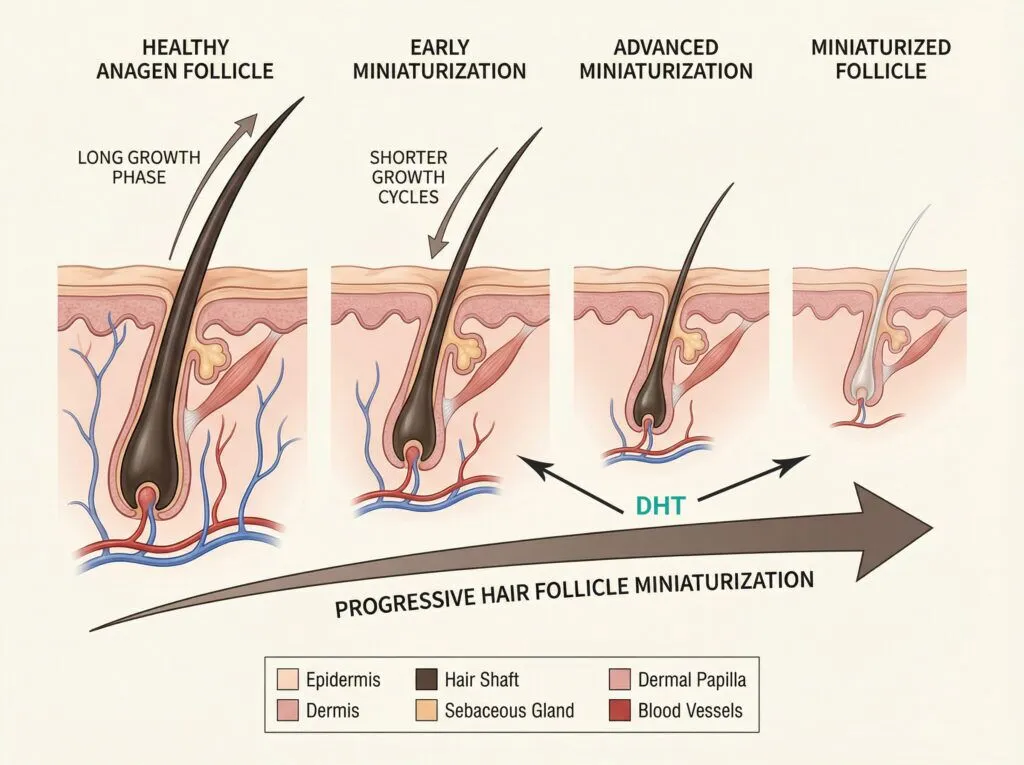
Why early intervention matters: recognising progressive thinning earlier may provide a greater opportunity to preserve existing follicles and improve long-term treatment planning.
Clinical Staging
Norwood–Hamilton & Sinclair Classifications
These are the recognised classification systems dermatologists use to describe pattern hair loss. They help understand how pattern hair loss is commonly staged — your exact stage is confirmed through clinical examination, not through comparison with an image.
Norwood–Hamilton Classification — Male Pattern Hair Loss
Early — I–III
Preserve + Stimulate
Moderate — III–V
Stabilise + Strengthen + Assess Restoration
Advanced — V–VII
Restore + Preserve Remaining Hair
Sinclair Classification — Female Pattern Hair Loss
Early — Stage 1–2
Preserve + Identify Contributing Factors
Moderate — Stage 3
Stabilise + Stimulate
Advanced — Stage 4–5
Maximise Existing Hair + Assess Restoration Options
These classifications help describe the pattern and severity of hair loss — diagnosis and treatment planning require clinical assessment.
The Method
Hair Restoration 360° Pathway
Five phases, shaped by diagnosis and stage — not a fixed package, but a method applied to every patient.
01
Diagnose
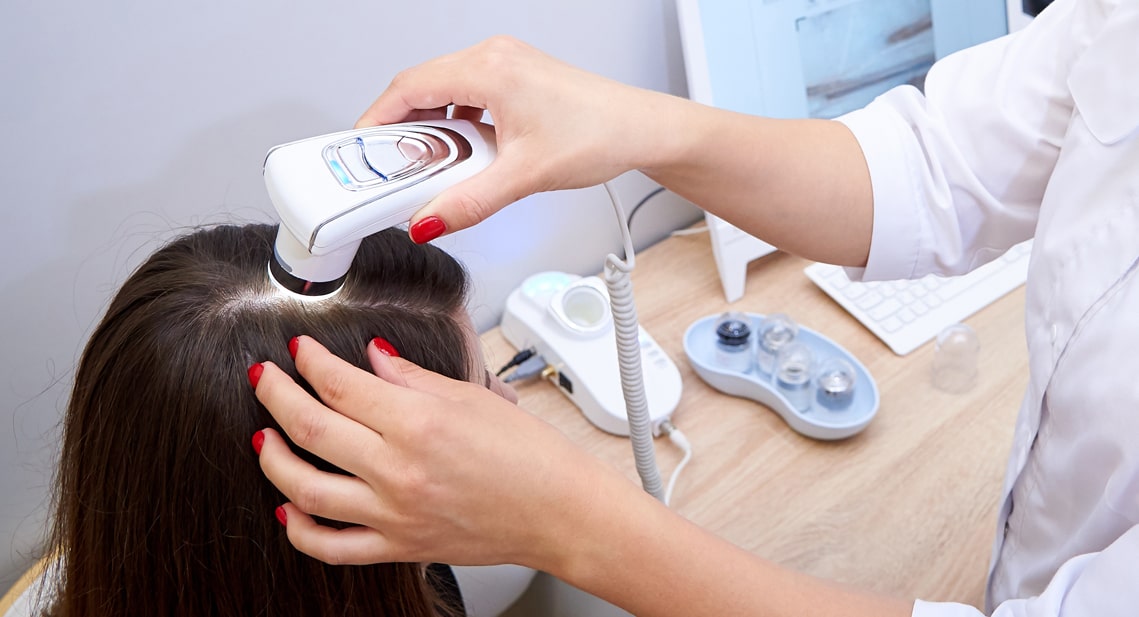
Identify the cause using history, scalp examination, trichoscopy and investigations where indicated.
02
Control
Stabilise active hair loss and treat underlying factors.
03
Stimulate
Improve the performance of existing follicles using appropriate medical and procedural treatments.
04
Restore
Address established density loss, including hair transplantation where appropriate.
05
Maintain
Protect existing and restored hair through personalised long-term maintenance.
Diagnosis comes first.
Treatment follows.
The Toolbox
Not one treatment. The right combination.
Modern hair restoration is rarely about choosing one procedure. Different treatments may address different aspects of hair loss — from controlling the underlying condition and preserving miniaturising follicles to providing regenerative support or restoring areas of established follicular loss.
Not every patient needs every treatment.
Diagnosis+ Hair-loss stage+ Follicular activity+ Scalp condition+ Medical suitability+ Previous treatments+ Patient goals
Foundation
Medical Therapy
The foundation of hair-loss management
Evidence-based topical and/or oral medications may be prescribed depending on the diagnosis, sex, age, medical history and severity of hair loss.
- Reduce progression of pattern hair loss
- Stabilise excessive shedding
- Preserve miniaturising follicles
- Improve hair growth
- Treat associated scalp conditions
Procedures should not automatically replace appropriate medical treatment.
Regenerative & Adjunctive Treatments
PRP
Platelet-Rich Plasma
Autologous Regenerative Therapy
Prepared from the patient's own blood by concentrating platelets, delivered into selected areas of the scalp as an adjunctive treatment in appropriately selected patients.
- Supporting existing follicles
- Improving hair calibre
- Complementing medical treatment
PRP is typically given as a short course of sessions, spaced a few weeks apart, followed by periodic maintenance depending on response — usually alongside medical therapy rather than in place of it.
GFC
Growth Factor Concentrate
Concentrated Autologous Growth-Factor Therapy
Prepared from the patient's own blood using a processing system to obtain a concentrated preparation of platelet-derived growth factors, for selected patients with hair thinning.
PRP and GFC are related, but not identical — preparation method and protocol may differ.
Ask which is suitable for me →
Microneedling
Controlled Scalp Stimulation
Controlled micro-injuries activate wound-healing pathways, and may be combined with topical or regenerative therapies.
Depth, frequency and combinations are customised by the dermatologist.
Mesotherapy
Targeted Intradermal Delivery
Small quantities of selected therapeutic agents delivered through multiple superficial scalp injections; formulation depends on diagnosis and protocol.
Different preparations vary widely. Does not eliminate the need for systemic therapy. Selected patients only.
LLLT
Low-Level Laser Therapy — Light-Based Hair Support
Low-level red-light therapy may be incorporated into selected hair-restoration programs as an adjunct, not a replacement for diagnosis and appropriate medical treatment.
Pattern hair lossCombination treatmentHome maintenanceLong-term strategy support
Advanced Regenerative Options
Advanced regenerative hair therapies
Selected treatments for selected patients — not routine procedures for everyone.
Exosome Therapy
Cell-Signaling Based Regenerative Approach
Exosomes are microscopic extracellular vesicles involved in cell-to-cell signalling. Exosome-based products are being explored in regenerative and aesthetic medicine, including hair restoration. In selected clinical settings, exosome-based scalp treatments may be considered as a regenerative adjunct.
- Supporting the follicular microenvironment
- Supporting cellular signalling around existing follicles
- Complementing other hair-restoration treatments
Emerging approach — product quality, regulatory status and evidence vary between products. Never described as a stem-cell transplant, a cure, or guaranteed regrowth.
May be considered after dermatologist assessment
Nanofat
Autologous Regenerative Scalp Therapy
Produced by harvesting a small amount of the patient's own fat, mechanically processed into a fine injectable preparation containing stromal and regenerative cellular components.
- Supporting scalp tissue quality
- Supporting the follicular microenvironment
- Complementing existing treatment
Step 1
Small-volume fat harvest
Step 2
Processing / emulsification
Step 3
Nanofat preparation
Step 4
Targeted scalp delivery
Nanofat does not replace established hair-loss treatment.
- Hair-loss diagnosis
- Stage of miniaturisation
- Existing follicular activity
- Donor fat suitability
- Scalp condition
- Previous treatment
- Patient expectations
Putting It Together
How do the treatments fit together?
Control
Control the Condition
Medical Therapy
Treat the underlying hair-loss process and preserve susceptible follicles.
Stimulate
Stimulate & Support Existing Follicles
PRPGFCMicroneedlingLLLTSelected Mesotherapy
Used individually or in carefully chosen combinations.
Advanced
Advanced Regenerative Adjuncts
NanofatSelected Exosome-based therapy
Considered in selected patients, not routinely used first-line.
Restore
Restore Established Loss
FUE Hair Transplant
Redistribute suitable donor follicles to areas of reduced cosmetic density.
The question is not:
"Which procedure is best?"
The better question is:
"What does my hair need at this stage?"
Book a Hair & Scalp Assessment
Selection Logic
Treatment selection matrix
Early Pattern Hair Loss
Objective
Preserve
Medical therapyMicroneedlingLLLTPRPGFC
Active Thinning
Objective
Stabilise + Stimulate
Medical therapyPRP / GFCMicroneedlingLLLTSelected mesotherapy
Selected Patients Needing Advanced Regenerative Support
Objective
Support the Follicular Environment
NanofatSelected exosome-based treatment
Established Follicular Loss
Objective
Restore
FUE Hair TransplantPreservation of surrounding native hair
After Improvement
Objective
Maintain
Medical therapyHome careSelected maintenance
Diagnosis → Stage → Treatment Selection
Not treatment first.
Restoration
When stimulation isn't enough
When significant follicular loss has occurred, medical and regenerative treatments may not provide adequate cosmetic density. Hair transplantation may then be considered.
FUE Hair Transplant
Suitable donor follicles are redistributed from the donor area to areas of established hair loss.
Receding hairline
Frontal hair loss
Established male pattern hair loss
Crown loss
Selected female patients
Selected scar-associated hair loss
A good transplant plan considers:
Current hair loss + donor density
+ future progression + realistic coverage
+ future progression + realistic coverage
Not simply graft numbers.
A hair transplant restores hair.It doesn't stop future hair loss.
Existing non-transplanted hair may continue to thin. Successful restoration may require:
Transplant + Preservation + Long-term Maintenance
Book Hair Transplant Assessment
Real Patient Results
Results From Our Own Patients
Real photographs from patients treated at Clear Skin Clinic. Shared with patient consent. Individual results vary depending on diagnosis, stage, adherence and treatment response — these are not a promise of similar outcomes for every patient.
Medical & Regenerative Therapy
FUE Hair Transplant
Photographs are of actual patients treated at Clear Skin Clinic, shared with their consent. Results, timelines and outcomes vary from patient to patient depending on diagnosis, stage and individual response — a consultation is the only way to know what may be possible for you.
What To Expect
Results take time
Hair grows in cycles0–3 Months
Control
Reduce active shedding and establish consistent treatment.
3–6 Months
Early Response
Changes in shedding and hair quality may begin becoming noticeable.
6–12 Months
Build
Improvement in responsive follicles becomes easier to assess.
Long Term
Maintain
Protect improvement and modify treatment according to progression.
Individual results and timelines vary according to diagnosis, severity and treatment response.
Before You Start
Common hair-loss mistakes
Taking supplements without knowing whether you need them
Assuming every type of hair loss needs PRP
Changing treatments every few weeks
Waiting until significant thinning becomes obvious
Stopping treatment immediately after improvement
Choosing a hair transplant based only on graft numbers
Diagnose first.
Treat second.

Hair Restoration, Designed By A Dermatologist
Dr. Nikita Patel
MBBS, DVD, DNB Dermatology · National-Level Gold Medalist · 14+ Years of Clinical Experience
At Clear Skin Clinic, hair restoration is approached as a medical diagnosis first and an aesthetic concern second. The aim is not to put every patient on the same procedure.
"We determine what is causing the hair loss, what can be preserved, what can be stimulated — and what needs to be restored."
What is causing the hair loss?
What can we preserve?
What can we stimulate?
What needs to be restored?
Dermatologist-Led Assessment
Panchpakhadi, Thane West
Hair Restoration 360° Program Lead
FAQs
Frequently asked questions
Book a Consultation
Start with a Hair & Scalp Assessment
Share a few details and we'll get in touch to schedule your assessment with Dr. Nikita Patel.
Don't wait for thinning to become obvious.
Find out what's happening to your hair.
Whether you've recently noticed increased shedding or have been dealing with progressive thinning for years, the first step is understanding the cause and stage of your hair loss.
Visit Us
Clear Skin Clinic, Thane
◔
Map / clinic exterior
embed to be added
Dr. Nikita Patel's Clear Skin Clinic
1, Amritraj Society, Panchpakhadi,Thane West, Thane, Maharashtra 400602